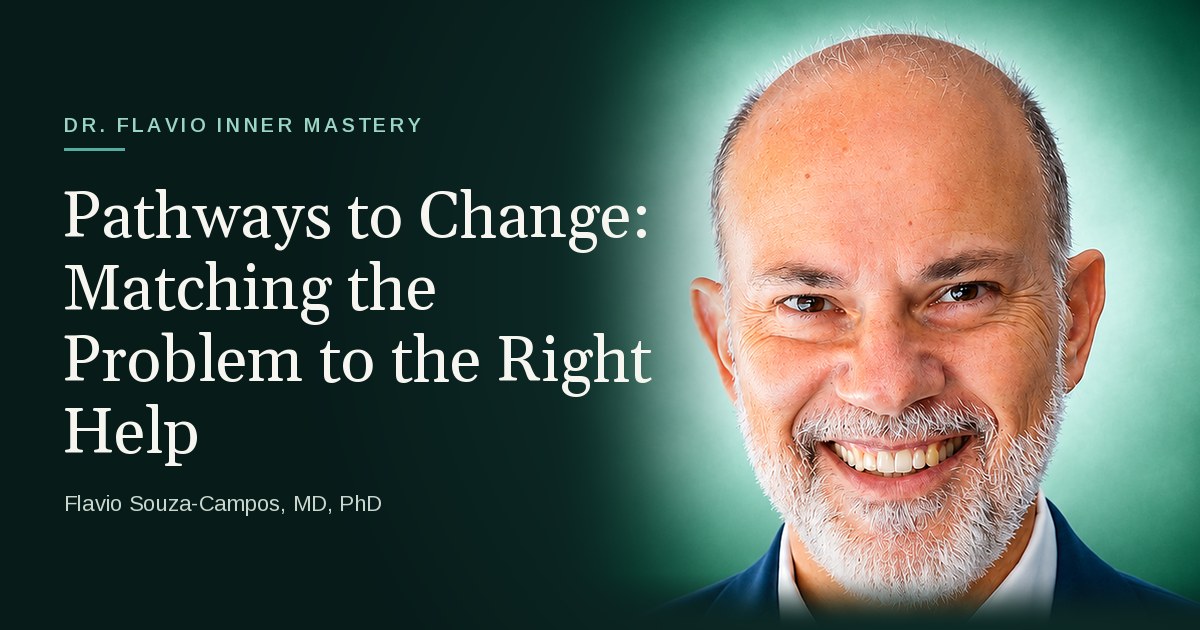
Why so much frustration in therapy comes from a mismatch, and what a part-time counselor, coach, or hypnotherapist can and cannot do for you.
Everyone wants to change something. For one person it is weight. For another it is smoking, or sleep, or money, or a relationship that keeps repeating the same painful pattern. For some it is a serious illness they want to overcome or at least live with more functionally.
Whatever the problem, the number of routes available to us is smaller than we think. Over many years of practice I have come to count seven. This article is about the first of them. But before describing it, I want to name the mistake that makes all seven harder to use.
The mismatch problem
In my work I see it constantly: people pair the type of problem they have with the wrong type of help.
An exaggerated example makes the point. Suppose you drive a car made by one manufacturer and take it to a dealer for another brand. They may be excellent mechanics, but they do not have the parts, the tools, or the know-how for your car. Push the example further: you take a broken motorcycle to a furniture store.
That sounds absurd, and it is meant to. Reducing an idea to the absurd is an old philosophical technique for making a pattern visible. Yet in the world of therapy and personal change we do something similar all the time. We seek a kind of professional who is not equipped for the problem we bring, and we leave frustrated.
The practitioner often leaves frustrated too. Most people in the helping professions are good people who want to help. When the problem and the pathway do not match, neither side gets what it hoped for.
Therapy is not the same as education
There is a second distinction worth making, one I explore in detail in my book The Philosophy of Therapy: the difference between therapy and education.
When I was in medical school, professors often told us to “educate the patient.” Over time I noticed when that advice tended to appear. It came up most for problems where conventional medicine had limited tools: heavy smoking, excess weight, drinking too much.
No one tries to educate a person through a heart attack. Medicine has diagnostic equipment, medications, and procedures for an acute heart attack, and it uses them.
This is not a criticism of education. Information is valuable. But it is worth noticing that when a professional falls back on the role of educator within what was supposed to be a therapeutic encounter, it is often because they do not have a tool that can bring about the change directly. Knowing this helps you ask a better question: Is this person equipped to help me change, or mainly to help me understand?
The first pathway: the part-timer
The first route to change is the part-time practitioner.
In medicine and academic psychology, part-timers are relatively uncommon. Those professions require long, expensive training and licensing, and people who make that investment usually practice full time, except perhaps near retirement.
In coaching, hypnotherapy, pastoral counseling, and many complementary modalities, part-timers are common. Among the hypnotherapists I have trained over the years, many practice part time. I think that is an excellent thing, and I have consulted part-timers myself.
What a part-timer is good for
A part-time practitioner can be a real treasure when what you need is:
- A sounding board for what is on your mind
- A place to be listened to without judgment
- Some relaxation or stress-reduction techniques
- A way to decompress after demanding days
- A perspective from someone outside your daily life
That might be a coach, a minister, a rabbi, a social worker who sees a few clients in the evenings, or a hypnotherapist who works on weekends.
The value often comes less from advice than from being understood. Sometimes we do not want feedback at all. We need to say what we think and feel to another human being, not to a wall, and to hear, in effect, “I understand you.” That alone can be therapeutic. Speaking it out can bring insights of our own. A person may come back two weeks later and say: after we talked I slept better, I realized something, I spoke with my spouse, and we made peace.
I have experienced this myself. After a demanding stretch of sessions, including clients dealing with a great deal of anger, I have called a part-time therapist and asked for a session. By agreement, they said very little. Speaking it out let me vent, reach my own insights, and let the discomfort go.
Used this way, on an ongoing basis, a part-timer helps keep stress from accumulating and can catch problems before they become severe.
What a part-timer is not for
The limitation is just as important. A part-time practitioner is generally not the right pathway for overcoming a major mental illness or a serious medical condition. The training, the skill set, and the tools are usually not there, and such conditions may require diagnosis, medication, or other medical and psychological care that a part-timer cannot provide.
A person with a serious condition can still benefit from a part-timer for stress relief and support. The mistake is to confuse that support with treatment of the underlying condition.
You can often recognize the difference when you call around: the level of organization, the fees, the availability, and the depth of training differ. None of that is a flaw, as long as no one pretends the service is something it is not.
Keep a part-timer in your contacts
In the old days we kept a Rolodex. Today it is the contacts on your phone. Either way, I suggest you keep a good part-timer in it, and see them regularly, before problems get out of hand.
The six remaining pathways suit other kinds of problems. The principle running through all of them is the same: match the outcome you want to the route and the professional suited to deliver it.
Watch the video
Watch on YouTube · Listen to the podcast episode
This article reflects the author’s educational perspective and is not medical or psychological treatment advice. People experiencing substantial or persistent distress should seek appropriate qualified care.