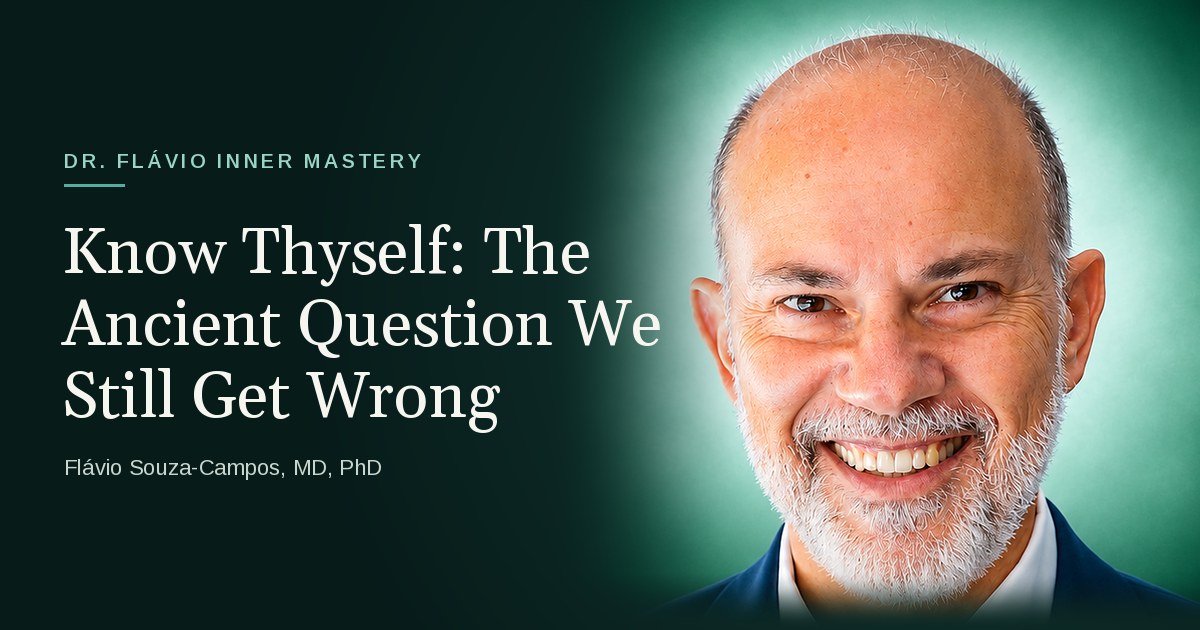
Above the entrance to the Temple of Apollo at Delphi, the ancient Greeks inscribed two words: Know thyself. The philosophers returned to the idea again and again. Socrates is remembered for saying that the unexamined life is not worth living.
Yet if you ask most people whether they know themselves, the answer comes quickly. Of course I do. My name is such-and-such, I live at this address, this is my job, this is what I do.
The man with the mirror
I once heard a story in a lecture that captures the problem well. A man walks into a very elegant bank, dressed in shorts and no shoes, to cash a check for a large amount. The teller examines the check. Everything looks legitimate. “Sir,” she says, “the check is fine, but now you must identify yourself.”
“Not a problem,” he says. He pulls a small mirror out of his pocket, looks into it, and announces: “Yep, that’s me.”
It is told as a joke. But it describes how many of us approach the question. I know me when I see me. Surely that is not what the ancients thought was important enough to carve above the door of a major temple.
There is a deeper sense of the word know. In the Bible, “Adam knew Eve” describes the most intimate kind of knowing, not the recognition of a name or a face. I suspect the philosophers at Delphi meant something closer to that: an intimate, direct acquaintance with oneself.
How people respond to “Who are you?”
In my practice I have noticed that the question “Who are you?” divides people. Someone with any inclination toward the inner life tends to engage with it: that is a good question, I am still trying to discover the answer. Someone who has never considered it often dismisses the question, and if you insist, may become uncomfortable or even irritated. To them, the question seems meaningless.
So how do we begin, with someone who is only now becoming curious about themselves?
Start by observing your own attention
We spend a great deal of energy wondering what other people think of us. We post things and count the views and the likes. We worry about the impression we make.
I should be honest here: I am not describing something I have mastered. People who know me know that I lean toward what psychologists call an anxious attachment style. How others see me matters to me. I have a long way to go.
But I can offer an exercise. Instead of wondering what others are thinking about you, pay attention to what you are thinking. Most of the time, we are not even aware of it.
A thought experiment: the crying baby
When my two older daughters were little, we played a game I called “scenarios.” I would describe an imaginary situation and ask: What would you do? How would you feel? They loved it, and as adults they still talk about those conversations. I have kept the habit, and I often use thought experiments in my work.
Here is one for you. For this exercise it does not matter whether you are a man or a woman: imagine you are a young mother. This is your first child, about eighteen months old. You walk into a quiet, rather elegant restaurant, and your baby begins to scream, inconsolably.
What is your very first thought?
Is it: What is happening with my child? Is he hungry, cold, tired, uncomfortable?
Or is it a wave of tension about what the people around you must be thinking of you?
This is not a question about how to discipline a child, or whether to do something about the crying. The point of the scenario is to reveal where the focus of your attention goes. I built it deliberately around a helpless child who depends entirely on you, because that is the situation in which it should be easiest to attend to someone else. And yet many people, if they are honest, will say that their first reaction is anxiety about how they look.
The same pattern in adult relationships
The pattern does not stay in restaurants. Some people spend their entire lives focused on what others think of them, even inside their most personal relationships.
I recently worked with a couple whose conflict centered on the man’s weight. He had gained around twenty pounds, and his partner kept complaining that he had become fat. When I spoke with him privately, he acknowledged the weight gain and said he had been under a great deal of stress. What struck him most was that she had never once asked him what was bothering him.
When I explored her complaint with her, the concern that emerged was about appearances: what would people think of her, being with a man who had let himself go?
Nobody thought his weight was her fault. That was not the point. The point is that in a close relationship we would expect some degree of support. If someone you love is suffering enough that it shows up in their eating, something is going on. Will your attention go to What is happening with you, and is there anything I can do? Or will it go to What will people think of me?
There is nothing wrong with wanting to look good
Let me be clear. Wanting to make a good impression, dressing well, speaking well: none of that is a problem.
The question is narrower. In a given moment, the focus of our attention is either on ourselves or on the other person. The extent to which you can forget yourself for a moment and attend to someone else is a measure of the love in your heart. It is how you actually come to know that the other person exists.
Learning that other minds exist
Developmental psychology offers an interesting parallel. A newborn appears to have no awareness that it and its mother are separate beings. Gradually, the child discovers that the mother is a different person, with a different mind. Philosophers discuss a related puzzle under the name “the problem of other minds”: how we come to know that other people have inner lives of their own.
Carl Jung described the work of life, and of therapy, as individuation: becoming fully oneself, distinct from others. I think that is half of the journey. The other half is the return: from a well-formed individual back toward a genuine connection with the whole, which begins with truly seeing the person in front of you.
Where to begin
Whichever reaction you recognized in yourself, we can all improve. If you notice that your attention mostly circles back to you, do not condemn yourself for it. Starting today, practice turning outward on purpose. For five minutes, look at someone and ask: How are you, really? What can I do for you?
That is a modest beginning. But knowing yourself includes knowing where your attention lives, and attention can be trained.
Watch the video
Watch on YouTube · Listen to the podcast episode
This article reflects the author’s educational perspective and is not medical or psychological treatment advice. People experiencing substantial or persistent distress should seek appropriate qualified care.